For curious clients and smart trainers. A working understanding of how EMS replicates the body’s own neural signal — and what that unlocks for strength, endurance, recovery and rehabilitation.
Basic concept
Electrical impulses, mimicking the brain.
EMS involves applying electrical impulses through electrodes placed on the skin over targeted muscles. These impulses mimic the body’s natural neural signals — the ones typically sent from the brain to the muscles to trigger contraction.
EMS bypasses the brain entirely. It stimulates the motor neurons directly, forcing the muscles to contract involuntarily — and, crucially, more completely than voluntary effort alone.
Scientific principle
The signal — replicated.
01
Brain sends signal
Muscles contract when the brain sends signals through motor neurons.
02
EMS replicates externally
EMS devices replicate this process by delivering controlled electrical currents to targeted muscle groups.
03
Both fiber types fire
This allows activation of both slow-twitch (endurance) and fast-twitch (strength/power) fibers.
How it works
Five mechanisms, one continuous loop.
EMS combines with regular exercise to enhance muscle activation during workouts. Each step below tunes a different variable in the contraction.
01
Electrical impulses EMS devices send electrical impulses to muscles via electrodes attached to the skin.
02
Muscle contraction The impulses mimic the natural action potential of the nervous system. The signals are stronger and more intense than voluntary contractions — stimulating more muscle fibers.
03
Intensity Intensity is adjustable to target different muscle groups at varying levels. EMS can intensify the contraction during squats, lifts, or planks — leading to faster strength, endurance and mass gains.
04
Frequency & duration Devices control how often impulses occur and how long each contraction lasts — tuned to the training objective: strength, endurance or recovery.
05
Recruitment Normally exercise recruits slow-twitch fibers first, then fast-twitch as intensity rises. EMS recruits all motor units simultaneously — often firing the larger, hard-to-reach fast-twitch fibers first.
Fiber recruitment
Two fiber types. One firing them both.
EMS recruits all motor units at once, often engaging the larger, fast-twitch fibers first — fibers that are typically hardest to reach in voluntary training.
Slow-twitch · Type I
Endurance
Sustained, low-intensity activity
Walking, jogging, posture
Recruited first in voluntary exercise
Activated during normal exercise progressively.
Fast-twitch · Type II
Power
Explosive, high-intensity movement
Sprinting, weightlifting, jumps
Hard to activate without EMS
Primarily activated by EMS — fueling strength & power gains.
EMS devices
Three families. One adjustable signal.
EMS hardware ranges from small consumer units to professional suits used in sports and rehabilitation. All consist of a control unit, electrodes and a power supply that generates the impulse.
Type A
Portable devices
Small, wearable EMS units used for targeted muscle stimulation — often worn during workouts.
Targeted muscle group
Wearable
Workout companion
Type B
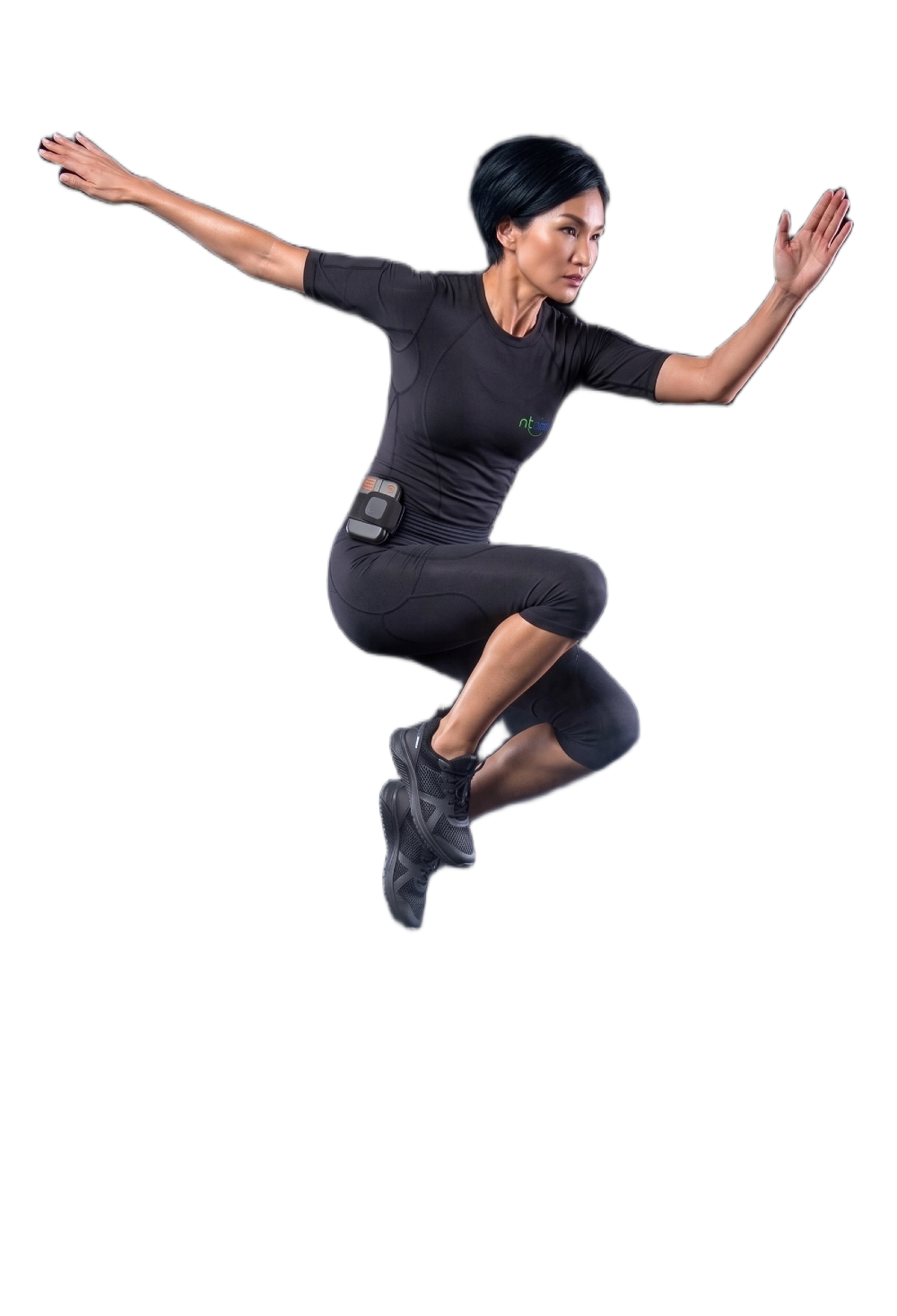
Full-body EMS suits
Worn by athletes and fitness enthusiasts during training sessions to engage multiple muscle groups simultaneously — a more holistic approach to EMS.
8+ muscle groups
Wireless / wired
Coach-supervised
Type C
Electrotherapy for rehab
Used by physical therapists to assist recovery from injury — focused on muscle re-education, pain relief and strengthening.
Clinical settings
Re-education
Pain relief
Frequency & intensity
Two tunings.
Low-frequency
Strengthening & recovery
High-frequency
Hypertrophy — muscle growth
Advantages
Seven advantages, beyond the gym floor.
EMS works alongside physical activity — never replacing it — to intensify contraction, accelerate recovery, and rebuild after injury. Each row below names one outcome.
Muscle hypertrophy & strength
01
EMS activates muscle fibers responsible for fast, explosive movement (Type II). These fibers respond strongly to resistance and grow faster — EMS contractions are often more intense than voluntary ones.
Rehabilitation & recovery
02
Prevents muscle atrophy when traditional exercise isn’t possible. Promotes recovery by increasing blood flow and clearing metabolic waste like lactic acid.
Therapeutic uses
03
Pain relief by stimulating sensory nerves that block pain signals. Muscle relaxation via continuous electrical pulses — useful in chronic conditions and spasms.
Targeted training
04
Electrodes can focus on a specific muscle group — abdominals for core, quads or hamstrings for legs — for measurable, isolated gains.
Time efficiency
05
More muscle fibers activated in a shorter window. Most sessions land in the 20–30 minute range — appealing for clients with limited time.
Complementing physical activity
06
Combines with weightlifting to intensify contraction. Combines with endurance work to drive repetitive contractions over longer periods.
Non-invasive & safe
07
External stimulation only. No surgery, no injections. Safe and non-invasive when used correctly under supervision.
Key concepts
The summary, in six lines.
A reference list — what to take away if you only remember six things from this page.
01
Electrical impulses
Cause muscles to contract involuntarily — mimicking natural neural signals.
02
Enhanced muscle recruitment
Activates more fibers, especially fast-twitch fibers difficult to engage in normal exercise.
03
Supplementary to exercise
Works alongside physical activity to intensify contraction during strength, endurance or recovery work.
04
Muscle growth & strength
Accelerates hypertrophy and improves strength by activating deep muscle fibers.
05
Rehabilitation & recovery
Used in injury recovery, pain relief, and preventing atrophy when conventional exercise isn’t possible.
06
Time efficiency
Stimulates muscles deeply in less time than traditional workouts.
Disclaimer
EMS works — under guidance.
EMS training is commonly seen in professional sports, fitness programs, and physical therapy settings to optimize performance and recovery. It’s important to use EMS under proper supervision or guidance to maximize its benefits and minimize risks.